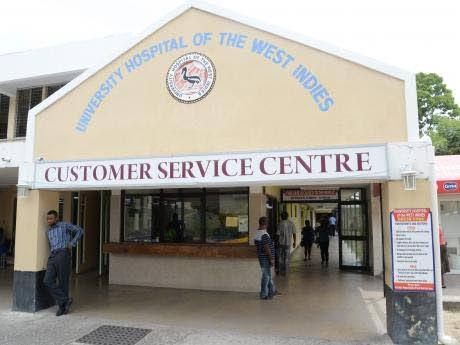
Auditor General Pamela Monroe Ellis has indicated that the actions of those behind the University Hospital of the West Indies (UHWI) customs tax-evasion scandal served to facilitate private entities in dodging taxes, thereby diverting resources from the public purse.
The auditor general’s performance audit of the institution revealed six instances in which UHWI utilised its tax-exemption status to facilitate the importation of goods belonging to four private companies, resulting in significant financial losses to the Government.
Giving an example of how the institution used its tax-exemption status to import medical equipment and other items for private companies, a performance audit placed under the microscope 12 dialysis machines to determine whether the items were included in UHWI’s inventory records and actually existed.
However, the auditor general said the UHWI did not provide the 12 dialysis machines and the other imported items for inspection.
According to Monroe Ellis, her department’s review of UHWI’s inventory records revealed that the last recorded set of dialysis machines was in January 2020, consisting of 24 AK98 dialysis machines received as a donation.
An audit inspection of the Dialysis Unit at the UHWI was done on July 2, 2025, where members of the audit team observed 26 dialysis machines, of which 15 (58 per cent) were out of service for various reasons and only 11 were operational. However, none of the 11 machines were from the set of 12 dialysis machines imported in 2024.
“Consequently, we found no evidence indicating that the imported goods and equipment were the property of the UHWI. Information from the customs agency showed that the broker paid the outstanding tax amount of $1.1 million with both cash and a credit card, which further suggests that the goods did not belong to UHWI.”
The auditor general pointed out that the imported items were supported by a UHWI undated declaration letter reflecting the name and signature of the former chief executive officer.
The audit report said the declaration letter certified that the referenced goods were imported solely for the UHWI and that import duty was exempt.
Additionally, the bill of lading designated current Chief Executive Officer Fitzgerald Mitchell as the consignee and a business designated ‘Private Company 2’ as the notifying party.
“Although the current CEO’s name and signature appeared on both the bill of lading and the C84 document, the CEO denied that the UHWI facilitated the import.”
PROMPT FOR FURTHER PROBE
According to the auditor general, the differing statements, combined with the lack of supporting documentation and the inconsistent representations across different customs forms, signalled the need for further investigation, given the misrepresentations about the true ownership of the imported goods and the loss of tax revenue amounting to $10.1 million.
Further, the UHWI used its tax-exemption status to facilitate the importation of laundry equipment, with cost, insurance and freight (CIF) valued approximately $28 million for a business, designated ‘Private Company 1’, yielding an estimated tax benefit of $6.6 million.
In another instance, the misuse occurred with the importation of office furniture and medical equipment, with CIF value of $40.6 million, and cups and dishes with a CIF value of $1.41 million, resulting in revenue losses totalling $10.7 million.
In its press release on Tuesday, the board of the UHWI said it had already begun implementing a structured reform programme before the tabling of the report, aimed at strengthening governance, improving documentation, and reinforcing oversight across the hospital.
With the tabling of the report, the board said it had moved to further accelerate and formalise actions that were already under way.
It indicated that a comprehensive review of all procurement systems referenced in the report has been directed, with a focus on identifying root causes and strengthening controls to safeguard transparency, compliance, and value for money.
The board said that the management has been instructed to regularise or suspend affected arrangements where appropriate and to reinforce oversight and compliance mechanisms without delay.