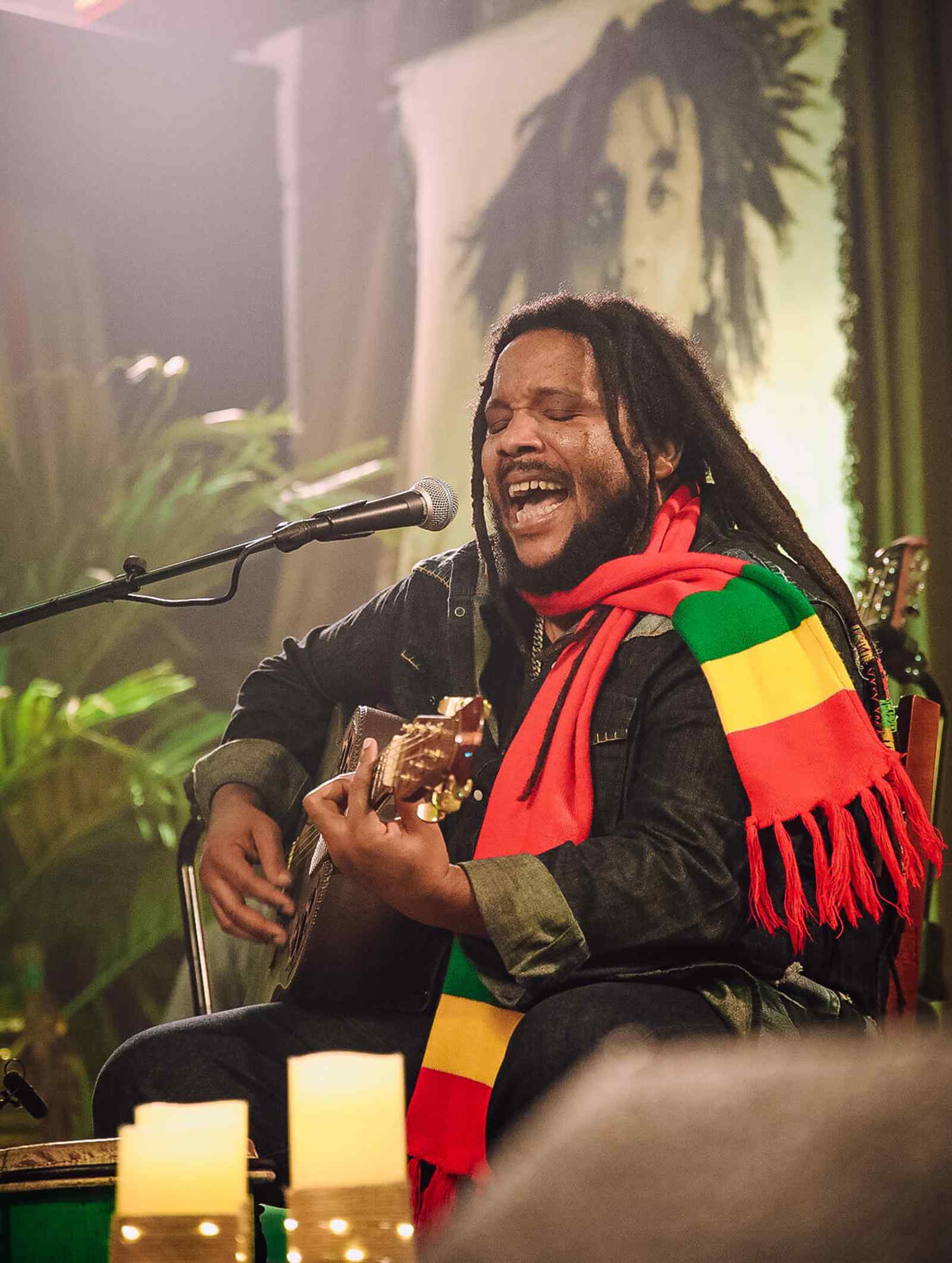
Low temperatures and strong gusts of wind were not enough to deter the public from venturing out in their numbers to celebrate Bob Marley’s 81st birthday at Emancipation Park on Friday August 6.
The event had an international flavour featuring performers from different parts of the world who paid tribute to the Gong in august style.
Leading the charge was Bob’s second son Stephen who brought true Marley magic to the proceedings.
He fused Marley classics with his own music and transformed Emancipation Park into a hot zone of culture and spirituality.
The crowd swayed to the reggae rhythms, lost in the moment.
He was supported by international acts from Indonesia, Ghana and Mexico as well as upcoming and established local artistes.
Families danced freely, children laughed, and the vibrant energy filled the air, turning the park into a sanctuary of joy and connection.
As live music permeated the night air, the event served up a chance for 2025’s festival song contest winner Abi D to strut her stuff performing “Sweet JA” She also chipped in with Marley classics “Roots Rock Reggae” and “One Drop”.
Things then took an international turn which gave the audience a chance to appreciate how reggae music has grown and developed outside of Jamaica. While the discerning ear could identify the gaps in authenticity that existed between the Jamaican and international performers there was nothing to note in terms of disparity of passions.
Indonesian performer Toke grabbed his opportunity with both hands delivering a lively reggae song which combined his skills of singing and deejaying.
It was then the turn of Kahpun from Ghana who delivered a rendition of Marley’s “Who The Cap Fit” and an original piece. He represented well and the Jamaican audience responded in kind to his mix of reggae and dancehall.
Reggae is doing big things in Mexico and the band Sangre Maiz demonstrated that. Theirs was a deep rootsy set delivered in both Spanish and English. They stuck to the fundamentals and proved why they have been chosen to back several Jamaican superstars on occasion. Their redition of Marley’s “Rastaman Vibration” underscored their ability to deliver authentic roots and dub music.
It was then time for the horns and big blaring horns they were. They call themselves Out of Control Army and they blew the house down. Rooted in early Jamaican music their energetic ska renditions brought the crowd to life with Latin and dancehall elements giving an interesting twist to one of Jamaica’s oldest genres. They were joined by Richie Stephens with a cameo of the Wailers’ “Simmer Down”. Overall their performance was well received and helped to inject some diversity into the night’s proceedings.
It was quite obvious that the foreign performers treat reggae music with respect and are fully dedicated to their craft. From hardcore reggae to ska they kept pace, and language barriers aside, delivered truly well for the king.
It was an electrifying fusion of sounds that resonated with the spirit of unity and celebration.
The female trio NAZ provided some thrilling harmonies with “Lively Up Yourself” and the I Three’s “He’s A Legend”.
Warrior King From his opener “Heathen” to Marley’s “So Much Things To Say” was among those who demonstrated that the future of reggae music is in safe hands.
For the first time Reggae Month has an ambassador and songstress Etana has embraced the role wholeheartedly. She represents the currency of the music and her roots reggae catalogue speaks volumes to the role she now performs. She is a natural and while high quality female reggae artistes have not cut through in the numbers expected, Etana has taken her work to a a very high standard. She began her set with the anatomy of reggae music breaking out how the different elements come together to make the music that everyone was there on occasion to celebrate. Her performance was enjoyable throughout.
Jemere Morgan, son of Morgan’s Heritage leader Gramps Morgan represented the third generation of that family of singers. He again showed that reggae is on a solid path effortlessly taking the crowd through his selections. He performed an interesting acoustic version of “Redemption Song” before making way for Bushman who reeled of his popular songs.
Cometh the hour cometh the man. Stephen Marley was at Emancipation Park to pay homage to his father and he brought all the soulfulness and spirituality that an audience could want on any one night. Playing his congas accompanied by an acoustic guitar he gave rhythmical interpretations of his father’s songs including “Trench Town Rock”, “Burning and Looting”, “Misty Morning” and “Easy Skanking”. He was joined by his brother Julian for “Three Little Birds”.
From signing to deejaying he brought the music in a different style. There were no big drum rolls with crashing timbales and cymbals. Instead what he presented was a mellow mood that transfused into his audience.
He then introduced a slew of dancehall acts including Spragga Benz, Ghost, Beenie Man, Richie Spice, Ras Shiloh, Capleton, Junior Reid among others.
Stephen then closed the event with more of hits and his father’s massive hit “Could You Be Loved” and the poignant “Lion of Judah”.
The resonance of the gathering echoed beyond the evening, planting seeds for future cultural events that would continue to uplift and inspire the community. Conversations buzzed with excitement as attendees exchanged thoughts about the performances, discussing the powerful messages woven into the lyrics and the importance of keeping the culture alive. Spirits were high, and there was a palpable sense of hope among the crowd, reaffirming their commitment to celebrating their roots.
With hearts full and dreams ignited, attendees left Emancipation Park, eager to share the experience and inspired to infuse their own lives with the rich culture they had celebrated together. The gathering was more than just a tribute concert; it was a powerful reminder of the strength found in unity and the importance of community in preserving a vibrant cultural legacy.